Epitalon research at Wellness Peptide Store
A synthetic peptide, a pineal extract and several different experiments. Separating them makes the telomere and sleep questions much clearer.
Epitalon and Epithalamin
Epitalon is a research compound made by joining four amino acids in the sequence Ala-Glu-Asp-Gly. Epithalon is another spelling of its name. Epithalamin is a peptide mixture extracted from cattle pineal glands; the synthetic tetrapeptide grew out of work on that mixture. The review of Epitalon’s origins and proposed properties describes this relationship.
For something so small, I expected a surprisingly tidy history. Instead, the similar names carry chemically different preparations into the same conversation. The distinction becomes decisive in the human survival paper: its participants received Epithalamin, sometimes alongside thymalin. They were never a trial of synthetic Epitalon.
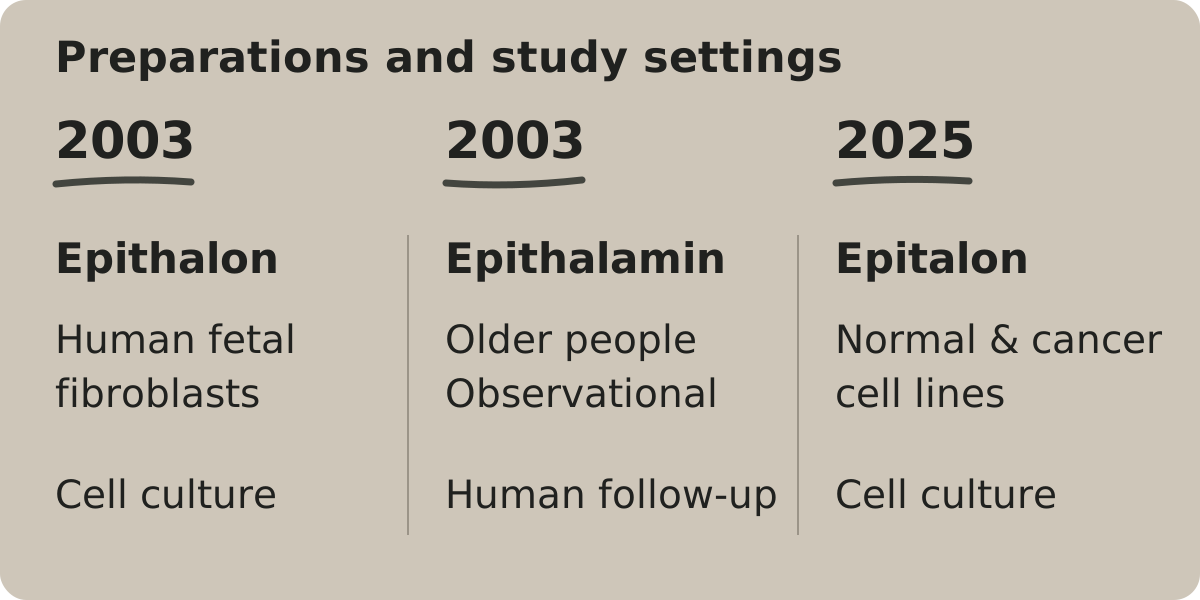
The timeline below separates the preparations from the study settings. Human cells grown in a dish and people receiving a preparation describe very different kinds of experiment.
Epithalon mechanism of action
In the 2003 experiment with human fetal fibroblasts, Epithalon induced expression of the catalytic telomerase subunit, telomerase activity and telomere elongation. Fibroblasts are connective-tissue cells. The cultures began without detectable telomerase activity; the finding concerns cells maintained outside a human body.
Telomerase helps rebuild the repetitive DNA at chromosome ends. An increase in that activity can explain longer telomeres in a culture. It leaves whole-body effects, delivery and lasting safety to be investigated separately.
The 2025 review also covers proposed melatonin, immune and gene-regulation effects, while acknowledging limited structural and physicochemical characterization. I’m surprised by how much biological ambition surrounds a molecule whose properties still need that basic work. A catalogue of proposed actions gives several research questions to pursue; it cannot supply their answers.
Telomerase and the cancer cell lines
A 2025 study of normal human cells and breast-cancer cell lines made the telomere story less uniform. Normal cells lengthened telomeres through increased hTERT expression and telomerase activation. In the breast-cancer cell lines, extension occurred largely through Alternative Lengthening of Telomeres, or ALT, another maintenance process.
Both outcomes came from cell culture. The paper establishes neither cancer causation nor cancer prevention in people, and the long-term implications of activating these pathways remain unresolved.
My hesitation over the general anti-aging claim starts with the breast-cancer cell finding. I’m still impatient for a precise account of which cells respond inside a body and what follows from that response.

Cultured rat pinealocytes
The sleep-related experiment used rat pinealocytes grown in culture. Epithalon stimulated AANAT, an enzyme involved in melatonin synthesis, and pCREB, a regulator of gene activity. Melatonin in the surrounding medium increased too. The experiment also examined the response alongside norepinephrine.
That is an interesting set of cellular measurements. Sleep quality in people would be a separate outcome, requiring a different study. Community accounts about sleep are discussed as anecdotes on the questions page.
The older human cohort
The observational study of 266 older people followed for 6–8 years associated Epithalamin, alone or combined with thymalin, with reduced mortality compared with untreated groups. Treatment was neither randomized nor placebo-controlled. Selection and other differences between the groups could contribute to the association.
The association deserves consideration. Swapping the preparation’s name loses me altogether. This paper cannot establish a survival benefit for synthetic Epitalon.
Epitalon has no human-treatment approval in major Western countries. Long-term randomized human safety data and published human pharmacokinetics remain lacking, and much of the foundational work comes from a single research lineage. The review of the research leaves substantial work on its properties and actions unfinished. Human benefit, human safety and the movement of the peptide through the body each remain open questions.